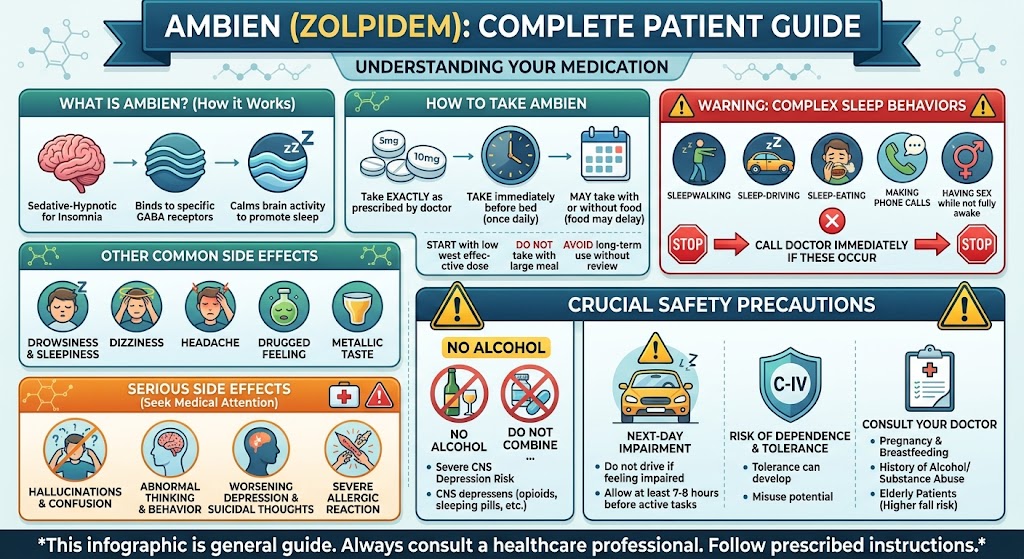
Ambien (Zolpidem): Complete Patient Guide
Quick Answer Box : Ambien is the brand name for zolpidem, a prescription sedative-hypnotic medication used for the short-term treatment of insomnia, specifically for individuals who have trouble falling asleep. It works by slowing down brain activity to induce sleep. Because it carries risks of complex sleep behaviors, dependence, and next-day impairment, it requires strict medical supervision.
Best Way to Buy Ambien Online
| Website | 5-Star Reviews | Shipping Speed | Action |
| Trusted Care | 110 Reviews | 2-5 Days | Click Here to Buy |
| Trusted Rx Dose | 220 Reviews | 1-2 Days | Click Here to Buy |
| Relief Rite | 362 Reviews | 3-7 Days | Click Here to Buy |
| United Rx Care | 150 Reviews | 2 Days | Click Here to Buy |
| Total Meds | 538 Reviews | 2-3 Days | Click Here to Buy |
Introduction
Chronic insomnia is more than just a frustrating inconvenience; it is a pervasive medical condition that severely impacts cognitive function, emotional well-being, and overall physical health. When behavioral changes and over-the-counter remedies fail to provide relief, healthcare providers often turn to potent, targeted prescription medications to help patients achieve restorative sleep. Ambien, widely recognized by its generic name zolpidem, is one of the most frequently prescribed sleep aids in modern medicine.
First approved in the 1990s, Ambien revolutionized the treatment of sleep disorders by offering a highly effective alternative to older, more addictive sedative classes. However, its powerful ability to rapidly induce sleep is accompanied by unique and profound risks, including the potential for complex, unconscious nighttime behaviors and physical dependence.
Understanding exactly how Ambien works, its highly specific dosage requirements, and the strict safety parameters surrounding its use is essential for patient safety. This comprehensive, evidence-based guide explores the clinical realities of Ambien to help patients navigate their treatment securely and effectively.
What Is Ambien?
Ambien is a potent prescription medication belonging to a class of drugs known as sedative-hypnotics, specifically referred to as non-benzodiazepine “Z-drugs.” Clinically, it acts as a central nervous system depressant. Because of its direct action on brain chemistry and its potential for abuse, physical dependence, and psychological addiction, the United States Drug Enforcement Administration strictly regulates Ambien as a Schedule IV controlled substance.
Ambien is available in a few different formulations to accommodate specific sleep needs:
- Immediate-release oral tablets (Ambien)
- Extended-release oral tablets (Ambien CR)
- Sublingual tablets (Edluar, Intermezzo)
- Oral spray (Zolpimist)
Immediate-release Ambien is designed to work very quickly, making it highly effective for people who struggle to fall asleep but generally stay asleep once they do. It has a very short half-life of roughly 2.5 to 3 hours, meaning it clears the body relatively fast, reducing the risk of a “hangover” effect the next morning compared to older sleep medications.
Is Ambien the Same as Zolpidem?
Yes. Zolpidem is the generic name of the active pharmaceutical ingredient, while Ambien is the most widely recognized brand name.
When a physician prescribes Ambien, the pharmacy will frequently dispense generic zolpidem. The FDA mandates that generic zolpidem must have the exact same active ingredient, strength, safety profile, and clinical efficacy as brand-name Ambien. The only practical differences are the physical appearance of the pill and the inactive ingredients (binders and fillers) used by different generic manufacturers.
How Ambien Works
To understand how Ambien induces sleep, it is helpful to look at the brain’s neurological communication system. The central nervous system relies on neurotransmitters to send signals between nerve cells.
The primary inhibitory neurotransmitter in the human brain is gamma-aminobutyric acid, commonly known as GABA. GABA functions as the brain’s natural “brake system,” slowing down electrical excitation to promote relaxation and sleep.
Ambien works by binding to highly specific sites on the GABA-A receptors—specifically the alpha-1 subunit, which is heavily involved in sleep induction. While traditional benzodiazepines (like Valium or Xanax) bind to multiple subunits causing muscle relaxation and anxiety relief, Ambien targets the sleep-inducing subunits almost exclusively.
By enhancing this natural braking system, Ambien rapidly depresses the central nervous system, effectively forcing the brain to transition from a state of wakefulness into sleep.
FDA-Approved Uses of Ambien
Ambien has a highly specific clinical profile. It is officially approved by the FDA for the following indications:
Short-Term Treatment of Insomnia
Ambien is strictly indicated for the short-term treatment of insomnia. Because the body can quickly build a tolerance to the medication, making it less effective over time, clinical guidelines generally recommend using Ambien for only a few days to a maximum of a few weeks. It is not intended to be a lifelong, nightly medication.
Sleep-Onset Difficulties
Immediate-release Ambien is specifically approved for patients who present with difficulties concerning sleep onset (the inability to fall asleep initially). For patients who have trouble maintaining sleep (waking up frequently in the middle of the night), providers may opt for the extended-release version, Ambien CR, which features a two-layer design to help initiate and then maintain sleep.
Benefits and Clinical Uses
When utilized strictly as prescribed, Ambien offers several significant clinical benefits for individuals suffering from acute insomnia:
- Rapid Onset of Action: Ambien works incredibly fast. Patients typically fall asleep within 15 to 30 minutes of taking the immediate-release tablet.
- Targeted Sleep Induction: Because it selectively binds to the alpha-1 subunit of the GABA receptor, it induces sleep without the heavy muscle relaxation or anti-anxiety effects of older drugs, which can leave patients feeling lethargic.
- Short Duration: The short half-life means that if a patient dedicates a full 7 to 8 hours to sleep, the drug will largely be cleared from their system upon waking, allowing for a clearer, more alert morning.
Dosage Information
Dosage for Ambien is highly individualized. In 2013, the FDA issued a critical safety requirement lowering the recommended starting dose, particularly for women, due to data showing that women clear zolpidem from their bodies at a significantly slower rate than men, leading to dangerous next-day impairment.
How to Take Ambien Safely
Because Ambien is a powerful central nervous system depressant, strict adherence to safety protocols is absolutely mandatory:
- Timing is Critical: Take Ambien immediately before you get into bed. Do not take it while watching TV in the living room or finishing chores, as it acts rapidly and can cause dangerous falls.
- Dedicate Time for Sleep: Only take Ambien if you have a full 7 to 8 hours to dedicate to sleeping. Taking it with fewer hours available significantly increases the risk of severe next-day impairment and amnesia.
- Empty Stomach: Take Ambien on an empty stomach. Taking it with or immediately after a heavy meal drastically slows its absorption, delaying sleep onset.
- Tapering is Mandatory: Never stop taking Ambien abruptly after continuous use. Abrupt cessation can cause severe rebound insomnia and withdrawal.
Common Side Effects
By intentionally suppressing brain activity to induce sleep, Ambien predictably causes side effects related to sedation and cognitive slowing.
Serious Risks and Warnings
The FDA requires several strict Boxed Warnings on Ambien due to its profound, life-threatening risks.
Complex Sleep Behaviors (Boxed Warning)
The most critical warning associated with Ambien concerns complex sleep behaviors. Patients have reported sleepwalking, sleep-eating, making phone calls, having sex, and even sleep-driving while not fully awake after taking zolpidem. Patients usually have no memory of these events. These behaviors can result in severe injuries or death to the patient or others. If a patient experiences a complex sleep behavior, Ambien must be discontinued immediately.
Dependence and Tolerance
Physical and psychological dependence can occur, even when taking Ambien as prescribed. The risk increases with higher doses, prolonged use, and in individuals with a history of substance use disorders. Tolerance develops rapidly, leading patients to require higher doses to achieve sleep, which drastically increases the risk of adverse events.
Next-Day Drowsiness and Cognitive Impairment
Even if a patient feels fully awake the morning after taking Ambien, their cognitive function and reaction times may still be severely impaired. This poses a profound risk of motor vehicle accidents. The risk is highest for women, older adults, and those taking the extended-release formulation.
Respiratory Depression
While Ambien alone rarely causes fatal respiratory depression in healthy adults, it suppresses the autonomic drive to breathe. If combined with other central nervous system depressants, especially opioids or alcohol, the breathing reflex can stop entirely, leading to hypoxia, coma, and death.
Drug Interactions
Ambien interacts dangerously with numerous substances. These interactions can drastically amplify the drug’s depressive effects on the brain and respiratory system, or alter how quickly the body clears the drug.
Who Should Avoid Ambien?
Ambien is contraindicated and should not be used in patients with specific underlying medical conditions or behavioral histories.
Pregnancy and Breastfeeding Considerations
Pregnancy: Ambien should be used during pregnancy only if the potential benefit justifies the potential risk to the fetus. Use late in the third trimester can cause the newborn to suffer from neonatal respiratory depression and withdrawal symptoms. Breastfeeding: Zolpidem is excreted in human breast milk in small amounts. Because infants cannot metabolize the drug efficiently, it can accumulate in their system, causing severe lethargy and respiratory depression. Breastfeeding while taking Ambien requires careful clinical consideration and monitoring.
Signs of Overdose
An Ambien overdose is a medical emergency that requires immediate, life-saving intervention. Call 911 immediately if you suspect an overdose.
Symptoms of an overdose include:
- Extreme drowsiness leading to unresponsiveness
- Mental confusion and severely slurred speech
- Profound loss of coordination
- Slowed, shallow, or irregular breathing
- Dangerously low blood pressure
- Coma
In emergency hospital settings, medical professionals may carefully administer Flumazenil, a specialized receptor antagonist, to rapidly reverse the sedative effects, though this is done cautiously due to the risk of triggering seizures.
Storage and Disposal
- Storage: Keep Ambien in its original, child-proof container at room temperature, away from moisture and direct heat. Because it is a controlled substance, it must be stored in a locked, secure location.
- Disposal: Unused medication should never be thrown in the household trash or flushed down the toilet. Utilize a DEA-authorized drug take-back program or pharmacy disposal kiosk to prevent accidental ingestion or illicit misuse.
Frequently Asked Questions
1. Is Ambien a benzodiazepine? No. Ambien belongs to a class of drugs called non-benzodiazepine hypnotics (often called “Z-drugs”). While it acts on the same GABA receptors in the brain as benzodiazepines, its chemical structure is entirely different, allowing it to target sleep induction with fewer muscle relaxant effects.
2. How long does Ambien stay in your system? Immediate-release Ambien has a short half-life of roughly 2.5 to 3 hours. It is generally eliminated from the blood within 12 to 15 hours, though it can be detected in urine drug screens for up to 24 to 48 hours depending on the test’s sensitivity.
3. Why do women require a lower dose of Ambien than men? Clinical studies revealed that women clear zolpidem from their bodies at a significantly slower rate than men. Taking the standard 10 mg dose left many women with blood concentrations high enough the next morning to cause severe driving impairment, prompting the FDA to mandate a 5 mg starting dose for women.
4. Can I drink a single glass of wine before taking Ambien? No. Medical guidelines and FDA warnings strictly prohibit any alcohol consumption on the same night you take Ambien. Combining these two central nervous system depressants exponentially increases the risk of fatal respiratory depression and complex sleep behaviors like sleepwalking.
5. Will Ambien cure my insomnia? No. Ambien manages the symptom of insomnia chemically; it does not cure the underlying physical or psychological causes of the sleep disorder, which are better addressed through Cognitive Behavioral Therapy for Insomnia (CBT-I).
6. Does Ambien cause weight gain? Direct metabolic weight gain is not a standard side effect. However, a dangerous complex sleep behavior known as “sleep-eating” is associated with Ambien, where patients consume massive amounts of food while asleep, which can lead to significant weight gain.
7. Why must I take Ambien on an empty stomach? Taking Ambien with or immediately after a heavy meal drastically slows down its absorption in the gastrointestinal tract. This means the drug will take much longer to induce sleep, and the sedative effects may linger into the next morning.
8. What happens if I wake up in the middle of the night on Ambien? If you wake up, you should remain in bed. You should never take a second dose of immediate-release Ambien in the middle of the night, as this guarantees you will not have the required 7 to 8 hours of clearance time, leading to severe next-day impairment.
9. How do I safely stop taking Ambien? You must work closely with your prescribing physician to create a tapering schedule, especially if you have used it for more than a few weeks. Abrupt cessation will almost certainly cause “rebound insomnia,” where your sleep problems return worse than before, along with potential withdrawal anxiety.
10. Is Ambien safe for elderly patients? It is used with extreme caution. Older adults are highly susceptible to over-sedation, confusion, and dangerous falls leading to hip fractures. Geriatric patients mandate a strict maximum starting dose of 5 mg.
11. What is the difference between Ambien and Ambien CR? Ambien (immediate-release) releases the medication all at once to help you fall asleep quickly. Ambien CR (controlled-release) consists of a two-layer tablet; the first layer dissolves quickly to induce sleep, while the second layer dissolves slowly to help you stay asleep throughout the night.
12. Can I split an Ambien CR pill in half? No. Ambien CR tablets must be swallowed whole. Splitting, crushing, or chewing the tablet destroys the time-release mechanism, flooding your system with the entire dose instantly, which is highly dangerous.
13. What is sleep-driving? Sleep-driving is a potentially fatal complex sleep behavior where a patient taking Ambien gets out of bed, starts their vehicle, and drives while not fully awake. The patient typically has zero memory of the event the next day.
14. Can Ambien alter my personality? In rare cases, Ambien can cause abnormal thoughts, severe agitation, aggressive behavior, or hallucinations, particularly if the patient fights the urge to sleep after taking the pill.
15. Does Ambien interact with over-the-counter medications? Yes. Combining Ambien with over-the-counter antihistamines (like Benadryl), cold medicines, or melatonin can cause severe, compounding sedation. Always consult your pharmacist before combining any medications.
Conclusion
Ambien (zolpidem) remains an indispensable pharmacological tool for the short-term management of severe sleep-onset insomnia, providing rapid and robust stabilization of the sleep-wake cycle.
However, the profound efficacy of Ambien is inextricably linked to unique and severe responsibilities. Its classification as a Schedule IV controlled substance and its FDA Boxed Warnings highlight the critical risks of complex sleep behaviors, dependence, and next-day cognitive impairment. By strictly adhering to prescribed, gender-specific dosages, understanding the absolute danger of combining it with alcohol or other depressants, and dedicating a full 8 hours to rest, patients can harness the therapeutic benefits of Ambien safely and effectively.